

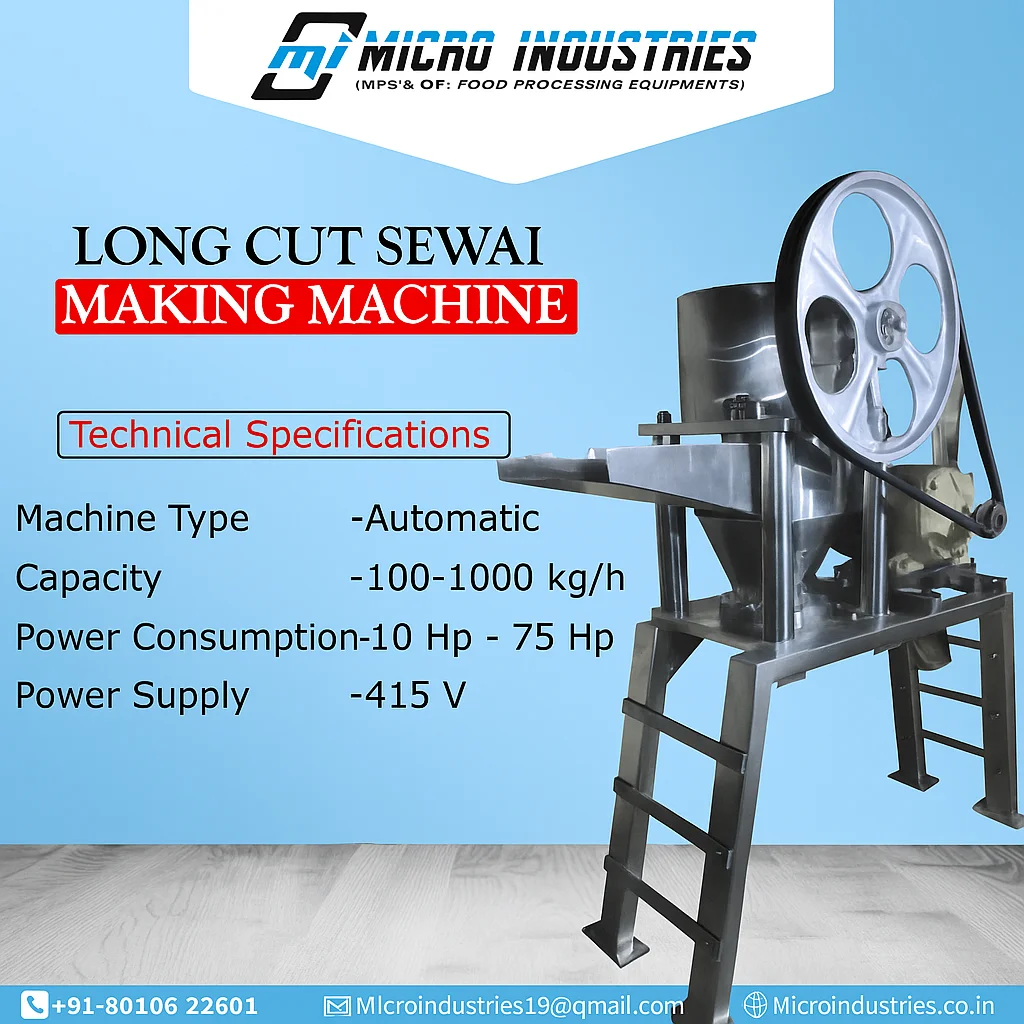
If you are looking for a reliable Shevaya Making Machine in Pune, Micro Industries offers machine solutions designed for efficient, hygienic, and consistent shevaya production. Shevaya, also known as vermicelli or sevai, is widely used in Indian households, sweet shops, food-processing units, restaurants, and commercial kitchens. As demand for hygienically processed and uniformly shaped food products continues to grow, businesses are increasingly choosing automated and semi-automatic machines instead of depending entirely on manual production.
A good shevaya making machine can help improve production consistency, reduce repetitive manual work, and maintain better control over the manufacturing process. Micro Industries focuses on providing food-processing machinery suitable for different production requirements, making it a practical option for businesses searching for a Shevaya Making Machine Manufacturer and Supplier in Pune.
Shevaya Making Machine in Pune
Pune has a growing food-processing and manufacturing sector, with many small businesses, food entrepreneurs, wholesalers, restaurants, and commercial kitchens looking for dependable machinery. A Shevaya Making Machine in Pune can be useful for businesses that want to increase production capacity while maintaining consistent product quality.
Traditional shevaya production can require considerable time and manpower. An automated machine can simplify several stages of production and provide more uniform output. Depending on the machine model, production requirements, and raw material, users can select equipment according to their desired capacity and operational needs.
Micro Industries can assist businesses in identifying a suitable machine based on production volume, product requirements, available space, and budget.
What Is a Shevaya Making Machine?
A Shevaya Making Machine is food-processing equipment used to produce vermicelli or shevaya in a controlled and efficient manner. The machine is designed to process the prepared dough or suitable food material and form it into the required thin strands.
For commercial production, maintaining uniformity is important because customers generally expect consistent size, texture, and appearance. A suitable machine can make production more systematic and help reduce dependency on manual shaping.
Businesses can use shevaya-making equipment for applications such as:
- Commercial vermicelli production
- Food-processing businesses
- Restaurants and catering operations
- Sweet shops
- Namkeen and snack manufacturers
- Small-scale food entrepreneurs
- Large-scale food production units
- Packaged food manufacturing
Why Choose a Shevaya Making Machine?
Investing in appropriate food-processing equipment can provide several operational advantages. Manual production may become difficult when order quantities increase. A machine helps create a more organized production process.
Consistent Production
One of the major advantages of machinery is consistency. A properly operated machine can produce shevaya with a more uniform shape and size compared with completely manual methods.
Improved Productivity
Commercial food businesses often need to produce larger quantities within limited working hours. A machine can help streamline production and reduce the time required for repetitive operations.
Reduced Manual Effort
Shevaya production involves repetitive activities that can require significant physical effort. Automation can reduce manual involvement in the production process.
Better Hygiene
Food-processing businesses need to pay attention to cleanliness and hygiene. Using appropriate food-processing machinery can help establish a more controlled production environment when combined with proper cleaning and handling practices.
Suitable for Commercial Businesses
A Shevaya Making Machine can be useful for businesses producing shevaya regularly for local markets, retail customers, restaurants, distributors, or wholesalers.
How Does a Shevaya Making Machine Work?
The exact operating process depends on the machine design and model. Generally, the prepared food material is placed into the machine’s designated feeding area. The machine then processes and forms the material into thin shevaya strands through a suitable forming or extrusion mechanism.
The produced shevaya can then undergo further processing, such as drying or packaging, according to the manufacturing method being followed.
Before purchasing a machine, businesses should understand the complete production process and ensure that the machine is compatible with their desired raw material and final product.
Applications of Shevaya Making Machines
The demand for vermicelli and shevaya is present across multiple food segments. A commercial machine can support different types of businesses depending on its capacity and configuration.
Food Manufacturing Units
Food manufacturers can use shevaya-making machinery as part of a commercial production line. The machine can help standardize production and support higher-volume operations.
Restaurants and Commercial Kitchens
Restaurants that prepare traditional Indian dishes may require shevaya regularly. In-house production equipment can be considered when the required quantity justifies the investment.
Sweet Shops
Shevaya is used in various traditional preparations and desserts. Sweet shops can use commercial equipment when they need regular production.
Catering Businesses
Large catering operations may require substantial quantities of ingredients. Suitable food-processing equipment can help businesses prepare products more efficiently.
Small Food Businesses
Entrepreneurs starting a vermicelli or shevaya manufacturing business can explore machines designed for their expected production requirements.
How to Select the Right Shevaya Making Machine in Pune
Choosing the right machine is an important part of setting up a successful production operation. Businesses should not select equipment based only on price.
Production Capacity
First, determine how much shevaya you need to produce per day. A small business may require a different machine compared with a large manufacturing unit.
Machine Construction
The machine’s construction and material should be appropriate for food-processing applications. Buyers should check the machine specifications and construction details before purchasing.
Ease of Operation
An easy-to-operate machine can simplify employee training and daily production. Ask the supplier about operating procedures, controls, and maintenance requirements.
Cleaning and Maintenance
Food-processing machinery should be cleaned regularly. Buyers should understand how easily the machine can be dismantled, cleaned, inspected, and maintained.
Power Requirements
Check electrical requirements and installation conditions before ordering. The available power supply at your production location should be compatible with the selected machine.
After-Sales Support
Technical assistance, spare parts availability, installation guidance, and service support can be important considerations for commercial machinery.
Why Consider Micro Industries?
When searching for a Shevaya Making Machine Supplier in Pune, businesses generally want more than just a machine. They also need guidance regarding machine selection, operation, installation, and maintenance.
Micro Industries provides machinery solutions for food-processing requirements and can help customers understand available options based on their production needs.
The right machine selection can depend on factors such as:
- Required production capacity
- Product specifications
- Available floor space
- Power availability
- Operating requirements
- Budget
- Future production expansion
Discussing these factors with the supplier before placing an order can help you select equipment that better matches your business requirements.
Benefits for Small and Medium Food Businesses
Small and medium-sized food businesses often operate with limited manpower and resources. Increasing production without proportionally increasing labour can be an important business consideration.
A suitable shevaya-making machine can help create a more structured workflow. Once operators become familiar with the machine, production can become easier to manage.
For entrepreneurs, machinery can also support business expansion. As demand increases, having suitable equipment can make it easier to manage larger orders.
However, buyers should always calculate expected production, operating costs, maintenance requirements, and return on investment before purchasing any commercial machine.
Shevaya Manufacturing Business in Pune
Pune provides opportunities for food businesses serving residential customers, restaurants, hotels, retailers, wholesalers, and other commercial buyers. Entrepreneurs interested in starting a shevaya manufacturing business can consider machinery as part of their production setup.
A typical setup may involve:
- Raw material preparation
- Dough or material preparation
- Shevaya forming
- Cutting or sizing, depending on the machine
- Drying or further processing
- Quality checking
- Packaging
- Storage and distribution
The actual process will vary depending on the product and production method.
Quality and Hygiene Considerations
Food products require careful handling throughout the production process. Machinery should be maintained properly and cleaned according to the manufacturer’s recommendations.
Operators should also follow appropriate food-safety practices, including clean working areas, proper ingredient storage, regular equipment cleaning, and hygienic packaging.
A machine alone does not guarantee food quality. The overall production environment, ingredients, operator practices, maintenance, and packaging process all contribute to the final product.
Maintenance of Shevaya Making Machine
Regular maintenance can help keep machinery working efficiently. Operators should follow the manufacturer’s maintenance instructions and inspect important components periodically.
Basic maintenance may include:
- Cleaning the machine after production
- Checking moving components
- Inspecting electrical connections
- Lubricating components where recommended
- Checking forming components
- Removing accumulated food material
- Replacing worn parts when required
Proper maintenance can also help identify potential issues before they cause significant production interruptions.
Get the Right Shevaya Making Machine for Your Business
If your business is searching for a Shevaya Making Machine in Pune, selecting the right equipment should begin with understanding your actual production requirements. Micro Industries can be considered for businesses looking for food-processing machinery suitable for commercial shevaya production.
Whether you are an established food manufacturer or an entrepreneur planning a new food-processing business, discussing your requirements with a machinery supplier can help you understand suitable machine options.
Before finalizing your purchase, ask about machine capacity, specifications, power requirements, installation, warranty, maintenance, spare parts, and after-sales service. This will help you make a more informed machinery investment.
Conclusion
A Shevaya Making Machine in Pune can be a useful investment for food manufacturers, restaurants, sweet shops, caterers, and entrepreneurs who require regular shevaya production. Compared with completely manual production, suitable machinery can help streamline operations, improve consistency, reduce repetitive labour, and support commercial production.
Micro Industries provides food-processing machinery solutions for businesses with different production requirements. By evaluating capacity, construction, operation, maintenance, power consumption, and after-sales support, buyers can identify a machine that fits their production setup.
If you are planning to purchase a shevaya-making machine, contact Micro Industries to discuss your production requirements and understand the available options.
Frequently Asked Questions (FAQ)
1. Where can I find a Shevaya Making Machine in Pune?
You can explore commercial food-processing machinery suppliers such as Micro Industries for Shevaya Making Machine requirements in Pune. Discuss your required production capacity and product specifications before selecting a machine.
2. Who is a Shevaya Making Machine Manufacturer?
A Shevaya Making Machine Manufacturer designs and produces machinery used for commercial shevaya or vermicelli production. Micro Industries offers food-processing machinery solutions for businesses looking for suitable production equipment.
3. What is a Shevaya Making Machine used for?
A Shevaya Making Machine is used to form prepared food material into thin vermicelli or shevaya strands for commercial food production.
4. Is a Shevaya Making Machine suitable for small businesses?
Yes, depending on the machine’s capacity and configuration, suitable equipment can be considered by small food businesses, startups, restaurants, and other commercial users.
5. How do I choose the right Shevaya Making Machine?
Consider your required production capacity, machine construction, available space, power supply, ease of operation, cleaning requirements, maintenance, budget, and after-sales support.
6. Can a Shevaya Making Machine increase production?
A suitable machine can streamline repetitive production processes and may help businesses handle larger production requirements more efficiently than completely manual methods.
7. What should I check before buying a Shevaya Making Machine?
Check machine specifications, production capacity, power requirements, construction, operating method, cleaning procedure, warranty, spare parts, installation, and service support.
8. Is Micro Industries a Shevaya Making Machine Supplier?
Micro Industries provides food-processing machinery solutions and can assist businesses looking for equipment for shevaya production. Buyers should discuss their specific requirements to identify the appropriate machine.
9. Can restaurants use Shevaya Making Machines?
Yes. Restaurants and commercial kitchens that regularly prepare shevaya or vermicelli-based products can consider suitable commercial machinery depending on their production volume.
10. Why should I choose a machine instead of manual shevaya production?
Machinery can help reduce repetitive manual effort, improve production consistency, and streamline operations, particularly when larger quantities need to be produced regularly.