

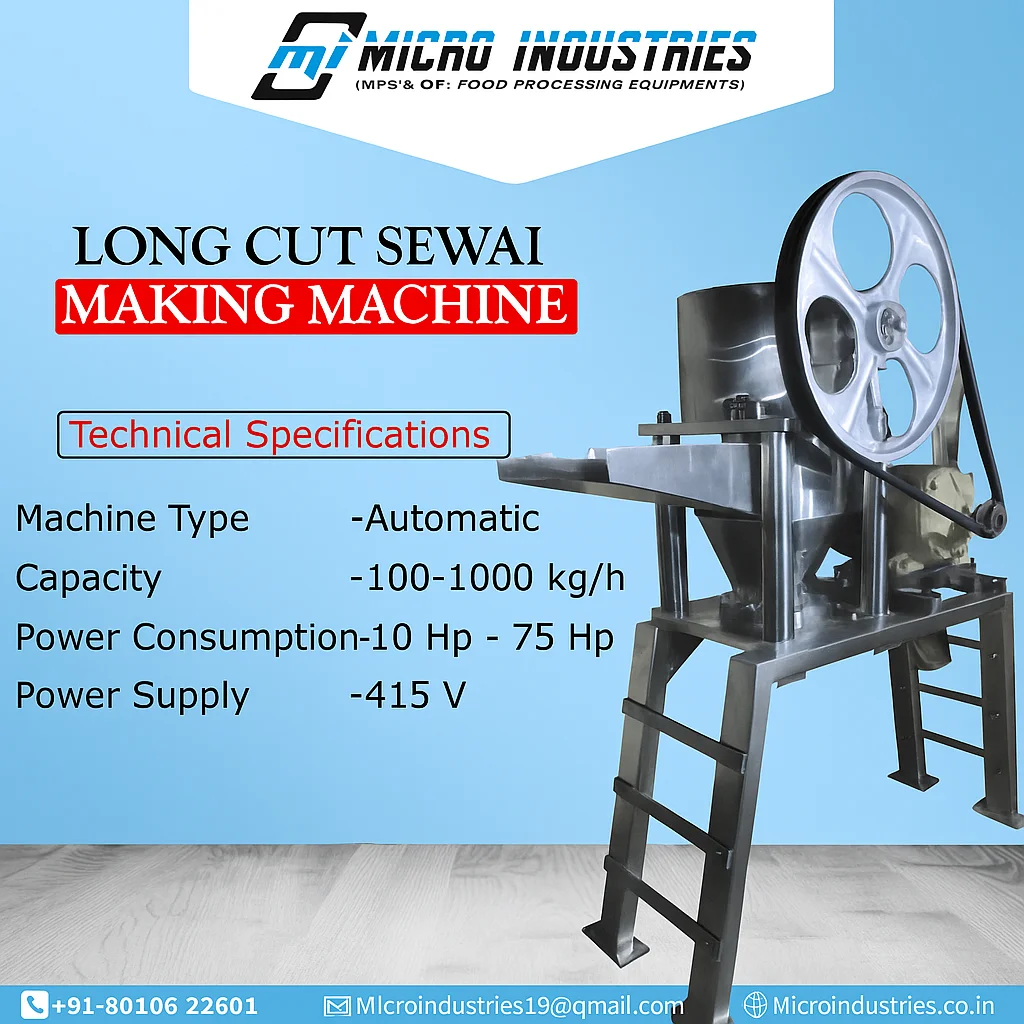
Introduction
Micro Industries offers efficient and reliable Shevaya Making Machine in Pune for businesses looking to manufacture high-quality shevaya, seviyan, and vermicelli products with improved consistency and production efficiency. Shevaya is widely used in Indian households, restaurants, sweet shops, food-processing units, catering businesses, and commercial food manufacturing facilities.
Traditional shevaya production can require significant manual effort, especially when businesses need to handle larger production quantities. A modern shevaya-making machine helps streamline the manufacturing process by providing controlled and consistent shaping, better production speed, and reduced dependence on manual operations.
For businesses in Pune and nearby industrial areas, selecting suitable food-processing machinery can make a considerable difference in day-to-day production. Micro Industries focuses on providing practical machinery solutions designed for commercial applications.
What Is a Shevaya Making Machine?
A Shevaya Making Machine is food-processing equipment designed to produce thin, uniform strands of shevaya or vermicelli from prepared dough or suitable raw-material mixtures. Depending on the machine configuration, the production process can include dough feeding, extrusion, forming, cutting, and collection.
The machine is designed to maintain consistency in the size and shape of the finished product. This is particularly useful for commercial manufacturers that need to produce shevaya in larger quantities while maintaining uniformity.
Businesses can select machinery according to their production requirements, available workspace, product specifications, and level of automation.
Shevaya Making Machine in Pune
Pune is an important commercial and industrial center with a growing food-processing sector. Food manufacturers, wholesalers, restaurants, caterers, and small-scale entrepreneurs require dependable machinery to improve their production capabilities.
A Shevaya Making Machine in Pune can be suitable for businesses involved in manufacturing and supplying:
- Shevaya
- Seviyan
- Vermicelli
- Thin pasta-style products
- Traditional noodle products
- Other compatible extruded food products
The exact application depends on the machine design, die configuration, raw material, and production requirements.
Key Features of Shevaya Making Machine
A good shevaya-making machine should provide a practical combination of production efficiency, consistency, ease of operation, and maintenance.
1. Consistent Product Formation
The machine helps produce shevaya strands with a more consistent shape and size. Uniform production can be useful when products are being packed and sold commercially.
2. Improved Production Efficiency
Compared with completely manual production, machinery can help reduce repetitive work and improve production workflow. This allows businesses to process larger quantities according to their production capacity.
3. Easy Operation
Commercial food machinery should be straightforward to operate. Properly designed controls and feeding mechanisms can make regular production easier for operators.
4. Robust Construction
Industrial food-processing equipment requires durable construction for regular use. Machine construction and components should be selected according to the intended production environment.
5. Easy Cleaning and Maintenance
Food-processing equipment needs regular cleaning. A machine with accessible components can make routine cleaning and maintenance more convenient.
6. Production Flexibility
Different businesses have different production requirements. Suitable dies and configurations can help manufacturers produce products according to their desired specifications, subject to machine compatibility.
Benefits of Using a Shevaya Making Machine
Investing in appropriate machinery can provide several operational advantages to food manufacturers.
Faster Production
Automated or semi-automated processes can increase production efficiency compared with extensive manual processing. This can be particularly valuable when demand increases during festivals and special occasions.
Better Uniformity
Machine-based production can help maintain consistent product dimensions. Uniformity is important for packaging, presentation, cooking characteristics, and customer expectations.
Reduced Manual Effort
A machine can handle repetitive forming and extrusion operations, reducing the amount of manual work required during production.
Suitable for Commercial Manufacturing
Businesses supplying shevaya to retailers, restaurants, distributors, and other commercial customers can use suitable machinery to organize production more efficiently.
Better Production Planning
With defined machine capacity and operating procedures, manufacturers can plan raw materials, manpower, packaging, and production schedules more effectively.
Applications of Shevaya Making Machine
A shevaya-making machine can be useful across different types of businesses.
Food Manufacturing Units
Commercial food-processing companies can use shevaya machinery as part of their manufacturing line for producing packaged vermicelli and related products.
Small and Medium Food Businesses
Entrepreneurs entering the shevaya manufacturing business can consider machinery according to their expected production volume and investment capacity.
Restaurants and Catering Businesses
Large catering operations and food businesses may require regular quantities of shevaya for different dishes and menus.
Sweet Shops
Shevaya is commonly used in desserts and traditional preparations. Commercial sweet shops may require consistent supplies for regular production.
Wholesale Suppliers
Distributors and wholesalers can source products from manufacturing units that use suitable production equipment to maintain consistent output.
Why Choose Micro Industries?
Micro Industries provides machinery solutions for different industrial and food-processing requirements. For businesses searching for a Shevaya Making Machine in Pune, choosing a supplier should involve considering machine specifications, production capacity, construction, maintenance requirements, and after-sales support.
Micro Industries focuses on providing practical equipment for businesses that want to improve their manufacturing process.
Before purchasing a machine, customers should discuss their production requirements with the manufacturer or supplier. Important factors may include the type of shevaya required, expected production quantity, available electrical supply, operating conditions, raw materials, and desired level of automation.
How to Select the Right Shevaya Making Machine
Selecting the correct machine is important for achieving the desired production results. Businesses should consider the following factors.
Production Capacity
Determine how much shevaya needs to be produced per hour or per day. The machine should match the business’s actual production requirements.
Machine Configuration
Different machine configurations may be suitable for different production processes. Discuss the required product and process with the supplier before finalizing the equipment.
Product Size
Shevaya can be manufactured in different thicknesses and specifications. The required die or extrusion arrangement should be checked for compatibility with the desired product.
Power Requirements
Check the machine’s electrical requirements and ensure that the production facility has a suitable power connection.
Installation Space
Measure the available production area before purchasing machinery. Adequate space should be available for operation, cleaning, maintenance, raw-material handling, and product collection.
Maintenance
Regular cleaning and maintenance are important for food-processing machinery. Ask about recommended maintenance schedules and replacement parts.
Shevaya Manufacturing Process
The general shevaya manufacturing process begins with preparing a suitable dough or raw-material mixture. The mixture is then introduced into the machine’s feeding system.
The machine applies controlled pressure to the material and passes it through an appropriate die to form thin strands. Depending on the machine design, the strands may then be cut or collected for further processing.
The produced shevaya may undergo drying or other required processing before packaging. The exact manufacturing procedure depends on the recipe, raw material, machine model, and desired finished product.
Maintaining proper hygiene throughout the process is essential for commercial food production.
Hygiene and Maintenance
Food-processing machinery should be cleaned regularly to prevent material buildup and maintain hygienic operating conditions. Operators should follow the manufacturer’s cleaning and maintenance instructions.
Important practices include:
- Cleaning product-contact areas regularly
- Removing leftover dough or material after production
- Keeping the machine and surrounding area clean
- Inspecting moving components
- Checking electrical connections
- Following lubrication requirements where applicable
- Replacing worn components when necessary
- Training operators in proper machine handling
Proper maintenance can help support reliable machine performance and extend equipment service life.
Shevaya Making Machine for Business Growth
Demand for convenient food products and packaged traditional foods creates opportunities for food manufacturers. Shevaya is used in several Indian recipes, including desserts and traditional meals.
For entrepreneurs, a suitable Shevaya Making Machine in Pune can help establish a more organized production process. Businesses can gradually develop their production capacity according to market demand, distribution networks, packaging requirements, and available resources.
However, machinery selection should always be based on the actual business plan rather than production capacity alone. Raw-material availability, packaging, storage, labor, electricity, quality control, distribution, and market demand should also be considered.
Conclusion
A Shevaya Making Machine in Pune can be a valuable solution for food manufacturers, restaurants, sweet shops, caterers, and entrepreneurs seeking to streamline shevaya and vermicelli production. The right machine can help improve production efficiency, maintain product consistency, reduce repetitive manual work, and support commercial-scale manufacturing.
Micro Industries provides machinery solutions for businesses looking for efficient food-processing equipment. Before purchasing, customers should evaluate production capacity, machine specifications, product requirements, available space, power requirements, maintenance, and after-sales support.
For businesses planning to expand shevaya production, investing in suitable machinery can help create a more systematic and scalable manufacturing operation.
Frequently Asked Questions (FAQ)
1. What is a Shevaya Making Machine?
A Shevaya Making Machine is food-processing equipment used to manufacture shevaya, seviyan, or vermicelli in a consistent shape and size. It is designed for commercial and production-oriented applications.
2. Who can use a Shevaya Making Machine?
Food manufacturers, restaurants, sweet shops, catering businesses, wholesalers, and entrepreneurs can use suitable shevaya-making machinery depending on their production requirements.
3. Is a Shevaya Making Machine suitable for businesses in Pune?
Yes. Businesses in Pune involved in food manufacturing and commercial shevaya production can select machinery based on their required production capacity, product specifications, and available infrastructure.
4. What are the benefits of using a shevaya machine?
A machine can help improve production efficiency, product uniformity, reduce repetitive manual work, and support larger-scale manufacturing.
5. Can the machine produce different sizes of shevaya?
Product size depends on the machine configuration and compatible dies. Customers should confirm the required shevaya thickness and specifications with the manufacturer before purchasing.
6. How do I choose the right shevaya-making machine?
Consider production capacity, product specifications, machine construction, power requirements, available space, operating method, maintenance requirements, and supplier support.
7. Is regular maintenance required?
Yes. Regular cleaning, inspection, and maintenance are important for maintaining hygienic and reliable machine operation. Maintenance should follow the manufacturer’s recommendations.
8. Can small businesses use a Shevaya Making Machine?
Yes, provided the selected machine matches the business’s production requirements, budget, available space, and infrastructure.
9. What raw material is used in shevaya production?
The raw material depends on the type of shevaya being produced and the desired recipe. Different formulations may require different processing conditions.
10. Where can I find a Shevaya Making Machine in Pune?
Businesses looking for a Shevaya Making Machine in Pune can contact Micro Industries to discuss their product requirements, production capacity, machine configuration, and other technical specifications before making a purchase.